Letras de música
Avril Lavigne - Keep Holding On (With Lyrics)
Avril Lavigne - Don't Tell Me (with lyrics)
Avril Lavigne - Girlfriend
Verb - Present Progressive / Continuous
Form
to be (am, are, is) + infinitive + -ing
Examples
Affirmative sentences: I am playing football. You are playing football..
Negative sentences: I am not playing football. You are not playing football.
Questions: Am I playing football? Are you playing football?
********************************************************
Present Progressive - Use
1) actions happening at the moment of speaking
Peter is reading a book now.
2) fixed plan in the near future
She is going to Basel on Saturday.
3) temporary actions
His father is working in Rome this month.
4) actions happening around the moment of speaking (longer actions)
My friend is preparing for his exams.
5) trends
More and more people are using their computers to listen to music.
6) repeated actions which are irritating to the speaker (with always, constantly, forever)
Andrew is always coming late.
Other Examples:
You are learning English now.
You are not swimming now.
Are you sleeping?
I am sitting.
I am not standing.
Is he sitting or standing?
They are reading their books.
They are not watching television.What are you doing?
Why aren't you doing your homework?
Text: On the telephone
Tracy: Hello, can I speak to Alex.
Alex: This is Alex, who is speaking?
Tracy: Hi, this is Tracy.
Alex: Hi Tracy. What are you doing?
Tracy: Oh, I'm just watching TV. What are you doing?
Alex: Well, I'm cooking dinner.
Tracy: What are you cooking?
Alex: I'm baking some potatoes, boiling some carrots and grilling a steak.
Tracy: It sounds delicious.
Alex: What are you doing for dinner tonight?
Tracy: Well, I don't have any plans...
Alex: Would you like to come over for dinner?
Tracy: Oh, I'd love to. Thanks.
Alex: Great. Mary and Jack are also coming. They are arriving at seven.
Tracy: OK, I'll be there at seven, too.
Alex: OK, see you then. Bye.
Tracy: Bye.
QUIZ -
click here: http://www.eflnet.com/grammar/presprog.php
Read more: http://www.englisch-hilfen.de/en/grammar/pres_pro.htm
http://www.englishpage.com/verbpage/presentcontinuous.html
http://www.englishclub.com/grammar/verb-tenses_present-continuous.htm
http://web2.uvcs.uvic.ca/elc/studyzone/330/grammar/pcont.htm
Verb - Simple Present
Infinitive
I want to work
He has to sing.
This exercise is easy to do.
Let him have one.
Simple Present
POSITIVE : I play tennis on Mondays.
NEGATIVE :They don't (do not) work in New York.
I like computers.
I don't like computers at all.
My friend likes computers.
My mum doesn't like computers at all.
QUESTION (Use the auxiliary do/does) : Does she know him?
Do you play football?
Does he play football?
Read more: http://www.englishclub.com/grammar/verbs-verb-forms_main.htm
http://www.englisch-hilfen.de/en/grammar/sim_pres.htm
http://www.englishpage.com/verbpage/simplepresent.html
Lesson 29-31-32
29. Like to do (part 1) + Do you like your job?
30. (missing...)
31. How long does it take?
32. Where do you live?
What's the best way to...
 What's the best way to the post office?
(Use the map for orientation.)
Excuse me, where is the post office, please? Turn right at the next corner. Then go straight on until you come to the traffic lights. Turn left there. The post office is opposite the cinema.
What's the best way to the cinema?
(Use the map for orientation.)
Excuse me, how do I get to the cinema? Go straight on. Turn left at the corner. Then take the second road on your right. Continue to the end of the road. Turn left there. The cinema is on your left, opposite the castle. Thank you very much. You're welcome.
Exercise:
http://www.quia.com/jg/65545.html
(with audio)
http://www.esl-lab.com/dir1/dir1.htm and http://www.esl-lab.com/dir2.htm
http://www.eslgold.com/speaking/giving_directions.htmlhttp://www.wakeupenglish.com/free_dialogues/files/dialbu12.swf
http://www.bbc.co.uk/worldservice/learningenglish/radio/specials/1655_how_to_ask/page2.shtml
Lesson 19-20
Asking and Giving Directions
How do I get to ...?
What's the best way to ...?
Where is ...?
Go straight on (until you come to ...).
Turn back./Go back./ Turn left/right (into ...-street).
Go along ..../ Cross ...
Take the first/second road on the left/rightIt's on the left/right.
straight on /opposite/ near/ next to / between
at the end (of) / on/at the corner
behind in front of/
(just) around the corner/
traffic lights/ crossroads, junction /signpost
19. Can you tell me the way to...?
20. Going (to a place)
- Where are you going?
- I am going to...
Lesson 15-16
15. Can you play any musical instruments?
- No I can not.
- No, I can´t. But my wife can.
- What can he play?
- He can play guitar.
- Can he play well.
- Yes, he can./ He plays (very well).
- No, the children can, though.
- No, and I can´t sing. I´m dreadful.
Can you cook?
What else can you do?
16. What are the French (people) like?
Lesson 13-14
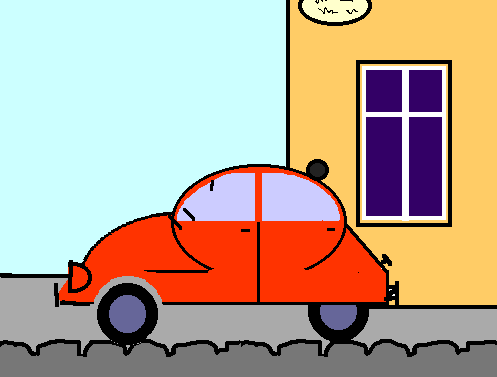
I want to buy a new car.
I want to buy a European car.
I want to buy a beautiful car.
http://www.paulnoll.com/Books/Clear-English/English-adjectives-3.html
http://www.paulnoll.com/Books/Clear-English/English-adjectives-4.html
http://www.lingolex.com/personalidad.htm
13. What are the Americans like?
14 - What are the British like?
Lesson 11-12
11. Are you married?
Making Question:
The basic structure of a question in English is very simple:
auxiliary verb + subject + main verb
Do you like Mary?
Are they playing football?
Will Anthony go to Tokyo?
Have you seen ET?
Exception!
For the verb be in simple present and simple past, we do not use an auxiliary verb. We simply reverse the positions of be and subject:
Statement: He is German.
Question: Is he German?
50 Basic English Questions:
http://esl.about.com/od/beginnerpronunciation/a/basicquestions.htm
Learn more:
http://www.englishclub.com/grammar/verbs-questions_types.htm
Exercise:
http://www.englishclub.com/grammar/verbs-questions_quiz.htm
http://www.englisch-hilfen.de/en/exercises/fragen3.htm
Wh-Questions Exercise:
http://a4esl.org/q/h/9704/dg-wh.html
http://a4esl.org/q/f/y/yz93fck.htm
http://a4esl.org/q/f/z/zz87mca.htm
http://a4esl.org/q/h/vm/queswor.html
12. Weather
What's the weather like?
It´s.... hot, raining, windy, sun, sunny, blowing, cloud, rain, wind, cloudy, rainy, shining, cold
Learn more:
http://esl.about.com/library/beginner/blweathervocabulary.htm
http://genkienglish.net/weatherml.swf
http://www.englishmedialab.com/elementaryvideos/seasons/seasons.html
Test your english - I

I am Mike. = My name is Mike.
You are Valerie. = Your name is Valerie.
He is Bruce. = His name is Bruce.
She is Helen. = Her name is Helen.
It is a monument. Its name is the Pyramid.
We are the Smith family. = Our name is Smith.
You are the Smith family. = Your name is Smith.
They are Mr. and Mrs. Smith. = Thier name is Smith.
A: Are you new here?
B: Yes, this is my first trip to the States. I arrived two days ago.
B: I came to the States as an exchange student. I plan to improve my English. I'll beliving with the Perrys for six months.
B: Thanks.
Positive
Do I run?
http://a4esl.org/q/h/lb/psv.html
Lessons 9-10

9. What time is it?
Read the short description below:
I usually get up at a quarter past seven - that's seven fifteen in the morning. I have breakfast at eight o'clock and then take the bus to work at half past eight. I usually arrive at work at a quarter to nine. Sometimes, the bus is late and I arrive at about nine. My morning is usually pretty busy and I like taking a coffee break at twenty to eleven if possible. I then work to lunchtime at noon. In the afternoon, I usually have another break at three fifteen. I usually finish work at a quarter to five and arrive home around six in the evening. At night, I usually go to bed at eleven o'clock.
Learn more and games:
http://www.time-for-time.com/lessons.htm
http://www.bbc.co.uk/wales/snapdragon/yesflash/time-1.htm
http://www.fi.edu/time/Journey/JustInTime/contents.html
http://www.dositey.com/math/time.htm
http://www.netrover.com/~kingskid/timeindex1.htm
http://www.primarygames.com/time/question1.htm
Telling Time - Worksheets:
http://www.enchantedlearning.com/time/
http://edhelper.com/Time.htm
10. The Jones Family
Read the following description of a family.
Jack is married to Alice. She is his wife and he is her husband. They have a daughter and son. The son's name is Henry and the daughter's name is Lisa. They live next to Alice's parents, Harry and Marjorie. Harry is Alice's father and Marjorie is her mother. Harry is Jack's father-in-law and Marjorie is his mother-in-law. Henry is Harry's grandson and Lisa is Marjorie's granddaughter. Alice has a sister and a brother. Her sister's name is Mary and her brother's name is Frank. Frank has two children, David and Sherrie. Sherrie is Alice's niece and David is Alice's nephew. Alice is their aunt and Jack is their uncle.
Your father's sister is your ___ (aunt)
Your sister's husband is your ___ (brother in law)
Your mother's mother is your ___ (grandmother)
Your sister's daughter is your ___ (niece)
Your son's son is your ___ (grandson)
Your sister's brother is your ___ (brother)
Your mother's brother is your ___ (uncle)
Your uncle's son is your ___ (cousin)
Your brother's son is your ___ (nephew)
Your mother's father is your ___ (grandfather)
Learn more:
http://www.learn-english-online.org/Lesson43/Lesson43.htm
http://www.englisch-hilfen.de/en/exercises_list/family.htm
http://learnenglish4freeonline.com/index.php?name=Topics&op=Open&id=9
Lesson 7-8
7. Astrological Sign
In astrology, the Signs of the Zodiac represent 12 equal segments or divisions of the zodiac:
Numbers in English:
Cardinal and Ordinal numbers - Matching and Exercise
http://www.englisch-hilfen.de/en/grammar/zahlen.htm
More exercise:
http://www.nonstopenglish.com/allexercises/vocabulary/Vocabulary-numbers.asp
8. Numbers
1 one /11 eleven... 10 ten
2 two /12 twelve... 20 twenty
3 three / 13 thirteen... 30 thirty
4 four / 14 fourteen... 40 forty (no "u")
5 five / 15 fifteen.... 50 fifty (note "f", not "v")
6 six / 16 sixteen... 60 sixty
7 seven / 17 seventeen ... 70 seventy
8 eight / 18 eighteen ... 80 eighty (only one "t")
9 nine / 19 nineteen... 90 ninety (note the "e")
If a number is in the range 21 to 99, and the second digit is not zero, one should write the number as two words separated by a hyphen.
21 twenty-one / 25 twenty-five
32 thirty-two / 58 fifty-eight
64 sixty-four / 79 seventy-nine
83 eighty-three /99 ninety-nine
100 one hundred / 200 two hundred / … … 900 nine hundred
Lessons 4-5-6
Hoje vamos aprender em Vocabulary:
- Colour (with "u" in UK, but it's spelled color in the USA.)
Continuando as aulas em vídeo
4- What´s your favorite color (colour)?
Test: http://a4esl.org/q/h/al-color-lb.html
Apples, salad, and grass are all usually ___
(green)
Buses in London, tomatoes and Rudolfs' nose are all ___
(red)
Taxis in New York, sweet corn and banana skins are all ___
(yellow)
The sky, Thomas the tank engine, and the sea are all ___
(blue)
Taxis in London, coal and a starless sky are all ___
(black)
Cherry blossoms, strawberry ice cream and pigs are all ___
(pink)
Chocolate, coffee and whiskey are all ___
(brown)
 Tomatoes are ___ (Red)
The sky is ___ (blue)
Clouds are ___ (white)
Grass is ___ (green)
Butter is ___ (yellow)
Eggplants are ___ (purple)
Carrots are ___ (orange)
Strawberry milkshakes are ___ (pink)
Coffee is ___ (black)
Chocolate is usually ___ (brown)
5- Nationalities
-Tom is from Berlin. His nationality is ___.
a. Germany b. German c. Dutch
Answer : b
- Anna is from Leningrad. Her nationality is ___.
a. France b. French c. Russian
Answer : c
- David is from New York. His nationality is ___.
a. Mexican b. American c. Canadian
Answer : b
- Sarah is from London. Her nationality is ___.
a. British b. Irish c. Scottish
Answer : a
-Nicole is from Paris. Her nationality is ___.
a. France b. French c. English
Answer : b
- Carlos is from Madrid. His nationality is ___.
a. French b. Italian c. Spanish
Answer : c
- Donald is from Geneva. His nationality is ___.
a. Switzerland b. Austrian c. Swiss
Answer : c
- Bruce is from Sydney. His nationality is ___.
a. British b. Australian c. Austrian
Answer : b
- Keiko is from Tokyo. Her nationality is ___.
a. Chinese b. Korean c. Japanese
Answer : c
- Dewa is from Jakarta. His nationality is ___.
a. Japanese b. Indonesian c. Indian
Answer : b
6-Introducing People
Part 1:
Lessons 1-2-3 and Alphabet
Para início, é básico saber:
.
- Greetings (= cumprimentos)
Hi!, Hello!, Hi there! (oi, você!)
Good morning, Good afternoon , Good evening, Good night
Nice to see you (again), Good bye, Bye (-bye) , See you (later) , See you soon. , See you tomorrow. ,See you next week (on monday)
- Personal Pronouns (=Pronomes Pessoais),
Verb to be (ser ou estar)/ Present Tense (no presente simples)
I am
You are
He/She/It is
We are
They are
Examples:
I am a teacher. You are a student. She is American. They are happy.
- Introducing /introduce yourself (Apresentar-se)
-Hi! What´s your name?
-Hello! My name is Peter, and you?
-I am Mary.
-Mary, this is John.
-How do you do? (formal) , você responde o mesmo: -How do you do?
Em outros casos, também é possível dizer:
-(It was) nice meeting you. , você responde o mesmo... ou ainda:
- Pleased to meet you.
- My pleasure.
Veja, ouvindo atenciosamente a pronúncia das frases nestes vídeos:
1 - Hi! What´s your name?
2- Where are you from?
Learn more:
-Are you American? No, sir. I am Australian. / I'm Australian.
-What nationality are you? I am Irish. -Oh! You're Irish!
-Where are you from? I'm from Cork.
-He's from Brazil. He's ___. (Brazilian)
-I'm from Colombia. I can speak ___. (Spanish)
-She's from Russia. She can speak ___. (Russian)
-We're from Italy. We're ___. (Italian)
-My friend is from Korea. He can speak ___. (Korean)
-Pablo is from Mexico. He's ___.(Mexican)
-Martha is from the United States. She's ___.(American)
-My father is from China. He can speak ___. (Chinese )
-Gloria is from Puerto Rico. She's ___.(Puerto Rican)
-Pierre is from France. He can speak ___. (French)
Obs! Nacionalidade em inglês são sempre com iniciais maiúsculas.
Lesson 3 - The Alphabet
...and now a cute Alphabet Song:
Esta música é bem legal aprender, pois é uma forma de gravar a pronúncia das letras do alfabeto!
Online tests:
http://www.easyenglish.com/index.asp
Resposta = key:
http://www.easyenglish.com/lesson.asp?is.txt
the word is...
adj. - fácil, tranqüilo
adv. - facilmente, tranqüilamente
idioms:
easy as pie - capable of being accomplished or done with no difficulty. (= capacidade de ser consumado ou feito sem nenhuma dificuldade)
take it easy não se preocupe
easy going complacente, despreocupado
easy money dinheiro (m) ganho sem esforç
Welcome!
 Welcome!
Sejam bem-vindos ao e-curso...
~Por que "easiness"? Porque é uma maneira fácil, simples, prática e sem esforço, assim como o título do blog, para aprender inglês.
EASY AS PIE
Eas'i·ness (n):
easy, simple, facile, effortless. (synonyms)
These adjectives mean requiring little effort or posing little if any difficulty. Easy applies to tasks that require little effort:
.
http://www.answers.com/easy
